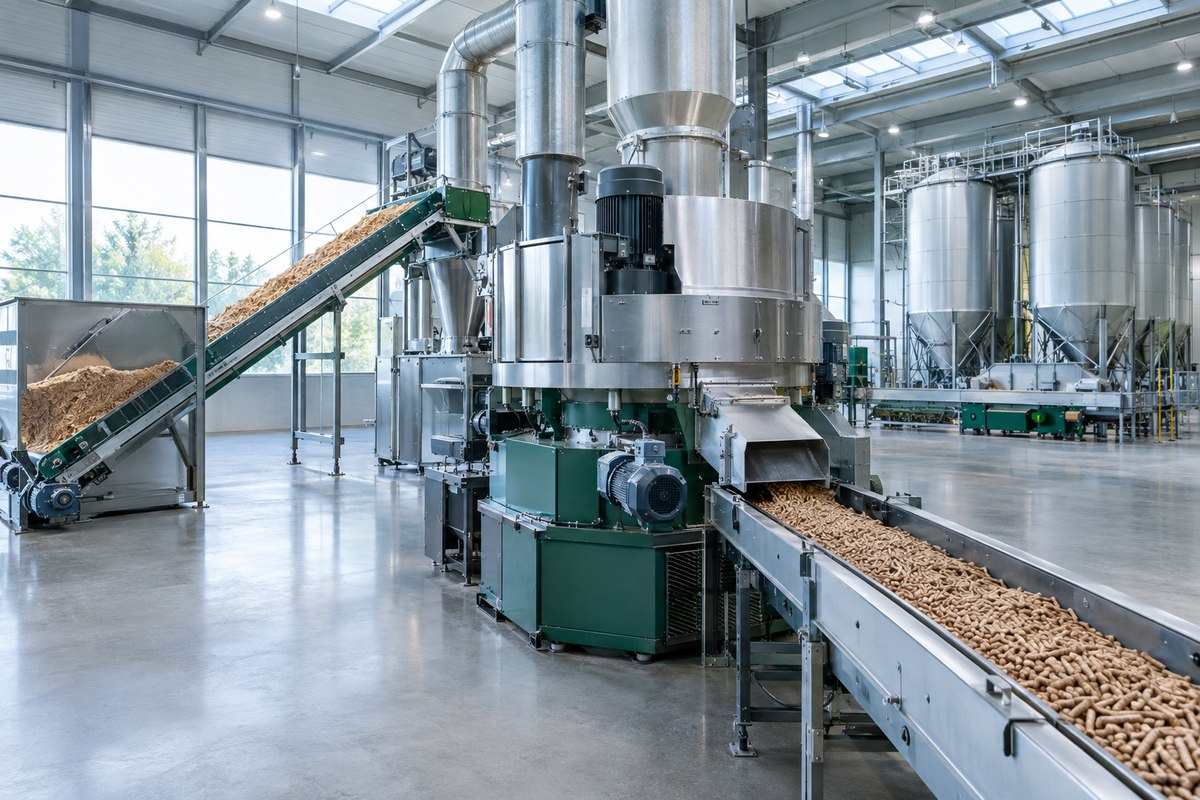
ENplus is an international wood pellet quality certification system run by the European Pellet Council (EPC), based on the EN ISO 17225-2 standard and covering the entire fuel supply chain — from feedstock control, through production, to trading, bagging, storage and transport to the end customer. An ENplus certificate confirms that pellets meet the strictly defined physicochemical parameters of one of the three quality classes (A1, A2 or B), and that the entity using the mark has implemented a quality management system ensuring the repeatability of those parameters in every batch. The ENplus mark is a legally protected trademark — it may only be used within the limits of a valid certificate.
Key takeaways
- ENplus divides wood pellets into classes A1, A2 and B; they differ in permitted feedstock, ash content (0.7 / 1.2 / 2.0%) and mechanical durability (98.0% for A1, 97.5% for A2 and B).
- Certification applies not only to producers — but also to traders and service providers: companies bagging, storing and transporting pellets.
- The system requires production monitoring, batch traceability, sampling and a documented procedure for handling nonconforming product.
- The audit is carried out by an independent certification body; the certificate is maintained through annual surveillance audits with laboratory testing.
- The indicative time from decision to certificate is 3–6 months; a consultant prepares the plant, but the certification body takes the certification decision.
What ENplus is and which classes it covers
ENplus was created on the initiative of the European Pellet Council — an industry organisation operating within Bioenergy Europe — in response to a problem that plagued both buyers and producers during the first decade of the pellet market's development: the lack of a common, enforceable quality standard. Product standards defined fuel parameters, but nobody ensured that a producer actually maintained them in every batch or that trade did not degrade the goods along the way. ENplus closed this gap by combining product requirements with system requirements for the entire supply chain — from the sawmill gate to the bag standing at the end customer's premises.
The foundation of the system is the EN ISO 17225-2 standard, which classifies wood pellets for non-industrial use (domestic boilers and small boiler houses). ENplus adopts the limits from the standard and tightens them at several points — the most important being the mechanical durability of class A1, which the system raises from the standard's 97.5% to 98.0%, and the fine fraction in bags, limited to 0.5% compared with the 1.0% permitted for bulk fuel. The governing documents of the system are the ENplus Handbook together with the ENplus ST series standards, which define requirements for companies, certification rules and the use of the mark.
The system distinguishes three pellet quality classes. The division primarily reflects the permitted feedstock (feedstock groups from EN ISO 17225-1) and the parameters that determine boiler operation: ash content, mechanical durability and the fine fraction.
Classes A1, A2 and B — limit parameters
Class A1 is the premium segment: pellets made from virtually bark-free feedstock (sawdust and shavings from debarked wood, clean wood chips), intended for top-class domestic boilers. Class A2 permits a share of bark and a slightly higher ash content — a typical pellet for boiler houses with automatic de-ashing. Class B covers pellets made from feedstock with a higher share of bark or forest residues, intended for boilers designed for fuel with a higher ash content.
| Parameter | ENplus A1 | ENplus A2 | ENplus B | Method |
|---|---|---|---|---|
| Diameter | 6 ± 1 mm or 8 ± 1 mm | ISO 17829 | ||
| Length | 3.15 < L ≤ 40 mm | ISO 17829 | ||
| Moisture (as received) | ≤ 10% | ≤ 10% | ≤ 10% | ISO 18134 |
| Ash (dry basis) | ≤ 0.7% | ≤ 1.2% | ≤ 2.0% | ISO 18122 |
| Net calorific value NCV | ≥ 16.5 MJ/kg (≥ 4.6 kWh/kg), as received | ISO 18125 | ||
| Mechanical durability | ≥ 98.0% | ≥ 97.5% | ≥ 97.5% | ISO 17831-1 |
| Fines < 3.15 mm | ≤ 1.0% in bulk; ≤ 0.5% in bags and sealed big-bags | ISO 18846 | ||
| Bulk density | 600–750 kg/m³ | ISO 17828 | ||
| Additives | ≤ 2% (production additives, to be declared on the packaging) | — | ||
| Ash deformation temperature | ≥ 1200 °C | ≥ 1100 °C | ≥ 1100 °C | ISO 21404 |
The table summarises the key limit values according to EN ISO 17225-2 and the ENplus Handbook; the full list of parameters (including nitrogen, sulphur, chlorine, arsenic and heavy metals) is contained in the standard. Values should always be verified against the current version of the scheme documents.
From the producer's perspective, the choice of class is a strategic decision: class A1 delivers the highest margin but requires clean feedstock and a stable drying and pressing process. Class A2 can be a sensible compromise for plants with access to bark-bearing sawdust, and class B for producers using forest chips or hardwood processing residues. The system allows several classes to be certified at a single plant, provided that production streams are physically and documentally separated.
Who is subject to certification: producer, trader, service provider
ENplus does not certify the product in the abstract — it certifies supply-chain entities within defined scopes. This is a key feature of the system: the quality mark can "survive" the journey from the production hall to the customer only if every link that physically takes over the pellets operates within the limits of a valid certificate or uses the services of a certified entity.
Production
The production scope covers plants manufacturing wood pellets — from feedstock intake to loading or bagging. The producer is responsible for classifying batches into classes A1/A2/B, process monitoring, sampling, labelling and maintaining the required conditions at the bulk pellet loading station — including separating the fine fraction before filling a vehicle or big-bag. The screening device must be capable of reducing the fine fraction content from a level of up to 10% to below the required 1.0%. The producer also keeps a complaints register and a product recall procedure.
Trading
The trading scope concerns companies that buy certified pellets and resell them without physically interfering with the product — as trade intermediaries, importers and exporters. If the trader merely concludes contracts and the goods never physically pass through its warehouses, certification has a simplified, documentary character. However, when a trading company physically takes over the pellets (unloading, storing, transhipping), it assumes responsibility for maintaining quality — and the audit requirements approach those of the service scope.
Service providers: bagging, storage, transport
The system provides three service scopes: bagging (packing pellets certified by the producer), storage (in silos, halls and warehouses) and transport (carriage of bulk and packaged pellets). A service provider does not classify the fuel but must ensure batch traceability, cleanliness of transport units and storage facilities, protection against moisture and contamination, and documentation that passes information about the quality class further down the chain. This solution allows, for example, a logistics company to provide services for several certified producers at once, without taking over responsibility for fuel parameters.
Every certified entity receives a unique ENplus identification code (in Poland with the prefix PL), which, together with the quality class, is a mandatory element of labelling. The European Pellet Council publishes the list of entities with valid certificates — as well as the list of companies whose certificates have been withdrawn; this is the first place to check when verifying a business partner.
ENplus system requirements
An ENplus certificate is not the result of a one-off pellet test. The system requires the implementation and maintenance of a set of procedures at the plant that guarantee the repeatability of quality. The certification audit checks documents, but above all their real application — records, labels, the condition of the screener, the way operators take samples.
Production monitoring
The producer must maintain continuous supervision over process and product parameters. In practice this means shift-based checks: measuring the moisture of feedstock and pellets, mechanical durability, bulk density and the fine fraction — at least once per shift or per batch, depending on the parameter and the measurement point specified in the handbook. Results go into records linked to the batch number. Key control points are the outlet of the pellet press, the cooler, the screening station and loading — each of these places can "spoil" a batch that was conforming at the previous stage.
Batch traceability
Every batch of pellets must have an assigned number that makes it possible to reconstruct: the feedstock used for production, the date and shift, control results, storage location and recipients. Traceability works both ways — from feedstock to customer and from a customer complaint back to a specific production shift. It is the foundation of the product recall procedure and the first area an auditor checks "live", asking for a batch from a silo to be pointed out and its history reconstructed.
Batch classification
The producer is obliged to assign every batch to a quality class on the basis of test results — not declarations. If a batch planned as A1 fails to meet even a single class parameter (most often ash or durability), it must be downgraded to A2 or B, or excluded from sale under the ENplus mark. "Averaging" results across batches in order to achieve conformity is prohibited.
Sampling
Samples for internal and laboratory testing are taken using methods compliant with the ISO 18135 series, from points representative of the batch — in practice most often from the stream on a conveyor or during loading. The system requires retention samples to be stored for a defined period so that the test can be repeated in the event of a dispute. A sample must be labelled with the batch number, date, sampling point and the person taking it.
Nonconformity management
The system requires documented handling of nonconforming product: quarantining the batch, marking its status, decisions on reprocessing, downgrading or destruction, and analysis of causes and corrective actions. In parallel, a customer complaints register operates — every quality complaint must be investigated and its outcome linked to the batch history. Recurring complaints about the fine fraction or slag in boilers signal to the auditor that the process or feedstock needs correction, not merely better segregation.
Personnel and subcontractors
The system requirements also extend to people and external companies. Employees who take decisions on batch classification, take samples or operate the screening station must be trained in the system requirements, and the plant is obliged to document this. Subcontractors — e.g. hauliers engaged for bulk deliveries or external warehouses — must operate either within their own service certificate or under the direct control of the certified entity, with the relevant procedures passed on to them. Commissioning transport to a company "outside the system" without such arrangements is one of those nonconformities that only surface when delivery documents are traced.
Records and documentation architecture
The system does not mandate specific software — records may be paper-based or electronic. What matters is that the documentation is complete, up to date and interconnected: the procedure describes what we do; the record proves that we did it; the test result justifies the batch classification decision. In practice, simple forms hung at workstations and linked by batch numbering to a central register work best. Elaborate ERP systems can help, but I have seen plants where a polished screen in the software did not translate into the missing measurements on the shop floor — the auditor looks at data, not the interface.
Labelling: bags, big-bags, tippers and documents
The ENplus mark is a protected trademark, and the rules for its use are set out in a separate part of the handbook. Only entities with a valid certificate may use the mark, within the limits of the granted class and scope. This restriction is enforced — the EPC carries out market monitoring, maintains lists of decertified entities and conducts proceedings regarding trademark infringements.
Bags and foil sacks
Retail packaging (typically 15 kg) must carry the ENplus mark together with the class designation (A1/A2/B) and the entity's identification code, e.g. PL 001. Alongside the mark, mandatory product information includes: pellet diameter and length, package weight, storage conditions, details of the producer or packing entity, and the batch number. The packaging design must be approved before being sent to print — a graphic change that was not reported can constitute an audit nonconformity even when the pellet parameters themselves are correct.
Big-bags
A big-bag is treated as a unit package: it requires a durable label with the mark, class, entity code, batch number and weight. Because a big-bag is a "sealed" container, the tightened fine-fraction limit applies to it — 0.5% at the moment of filling, as for bags. Bagging certified pellets by a third party requires that party to hold a certificate in the bagging scope.
Bulk deliveries — tippers and tankers
For bulk deliveries (tippers, pneumatic tankers delivering to domestic silos), the "packaging" is the documentation: every delivery must be documented with the quality class, the supplier's ENplus code, the batch number, the weight and the test results or a reference to the batch specification. Before loading, the pellets pass through a fine-fraction screening station — this is a system requirement, not good practice. The driver or station operator is responsible for the cleanliness of the transport unit; residues of another fuel or mineral dust in the cargo bed are a classic nonconformity.
Commercial and promotional documents
The ENplus mark on invoices, offers, websites and advertisements is subject to the same rules as on packaging: it may be used only in relation to the class covered by the certificate and in compliance with the mark's graphic guidelines. A trader certified in the trading scope may use the mark in documents but may not label its own packaging with it unless it also holds the bagging scope.
The certification process and the role of national certification
Certification is carried out by an independent certification body — an entity accredited (as a rule under ISO/IEC 17065) and approved to operate in the scheme by the European Pellet Council or the national licensor. The EPC publishes the list of active bodies; in Poland, audits are conducted by national and international bodies, often combining ENplus with other schemes (e.g. SURE) in a single audit visit.
A typical process looks as follows:
- Gap analysis — assessing the plant against the handbook requirements: feedstock, process, monitoring, labelling, documentation. On this basis, an action plan with responsible persons and deadlines is drawn up.
- System implementation — developing or updating procedures, record forms, sampling instructions and label templates; launching shift checks and the retention-sample archive; staff training.
- Internal audit — a full dry run through the system requirements, with a nonconformity report and corrective actions before the certification body comes in.
- Contract with the certification body and initial audit — the auditor verifies documentation and shop-floor practice and takes product samples for laboratory testing.
- Product testing — the full set of parameters of the target class in a laboratory indicated by the body.
- Certification decision and registration — once any nonconformities have been closed, the body issues the certificate, and the entity is entered on the EPC list and receives its identification code.
- Surveillance — an annual surveillance audit with sampling; serious nonconformities or test results outside the limits lead to suspension or withdrawal of the certificate.
The role of national certification (national licensor)
The system is managed at two levels. The European Pellet Council maintains the handbook, the trademark and the global lists of certified entities, while in countries with a large pellet market it delegates some functions — auditor training, approval of certification bodies, supervision of mark usage on the national market, licence fees — to national licensors (usually national pellet associations). For a plant, the difference is mainly administrative: the certification agreement is signed with the body, and the scheme fee reaches the appropriate level through it. It is worth checking before starting whether a national licensor operates in the given country, as this affects the level of fees and the language of documentation.
An important distinction to close this section: a consultant prepares the organisation for the audit but does not issue the certificate and does not guarantee the outcome. The decision — including the assessment of nonconformities and test results — rests exclusively with the certification body.
Feedstock control and certification
Pellet quality begins in the feedstock yard. The EN ISO 17225-1 standard defines the feedstock groups permitted for the individual classes: for A1 these are practically only sawdust, shavings and chips from debarked or fresh, chemically untreated wood; class A2 permits a greater share of bark and wood with bark; class B — forest residues and feedstock with an elevated ash content. The common denominator of all classes is the ban on chemically contaminated feedstock: painted, varnished or impregnated wood, and waste containing glues and boards.
The system requires the producer to maintain documented control of deliveries: specifications for suppliers, assessment at every intake (visual — mineral contamination, litter, mould; moisture measurement; identification of species and fraction) and a feedstock register linked to production batches. Suppliers should be evaluated and periodically reviewed, and nonconforming deliveries — segregated and rejected or directed to a lower-class batch if the nature of the nonconformity allows it.
A separate topic is "silent" contamination that only emerges in the laboratory: elevated chloride or sulphur content from fresh forest chips stored on bare ground, road dust on sawdust from a yard next to an unpaved road, paint residues in joinery waste. That is why a feedstock testing programme — not only product testing — is an element auditors look for in mature quality systems. Feedstock origin certificates (e.g. FSC, SURE, KZR INiG) do not replace ENplus quality control, but they make it easier to document the legality and sustainability of the source, which export buyers increasingly ask about.
Laboratory testing and testing frequency
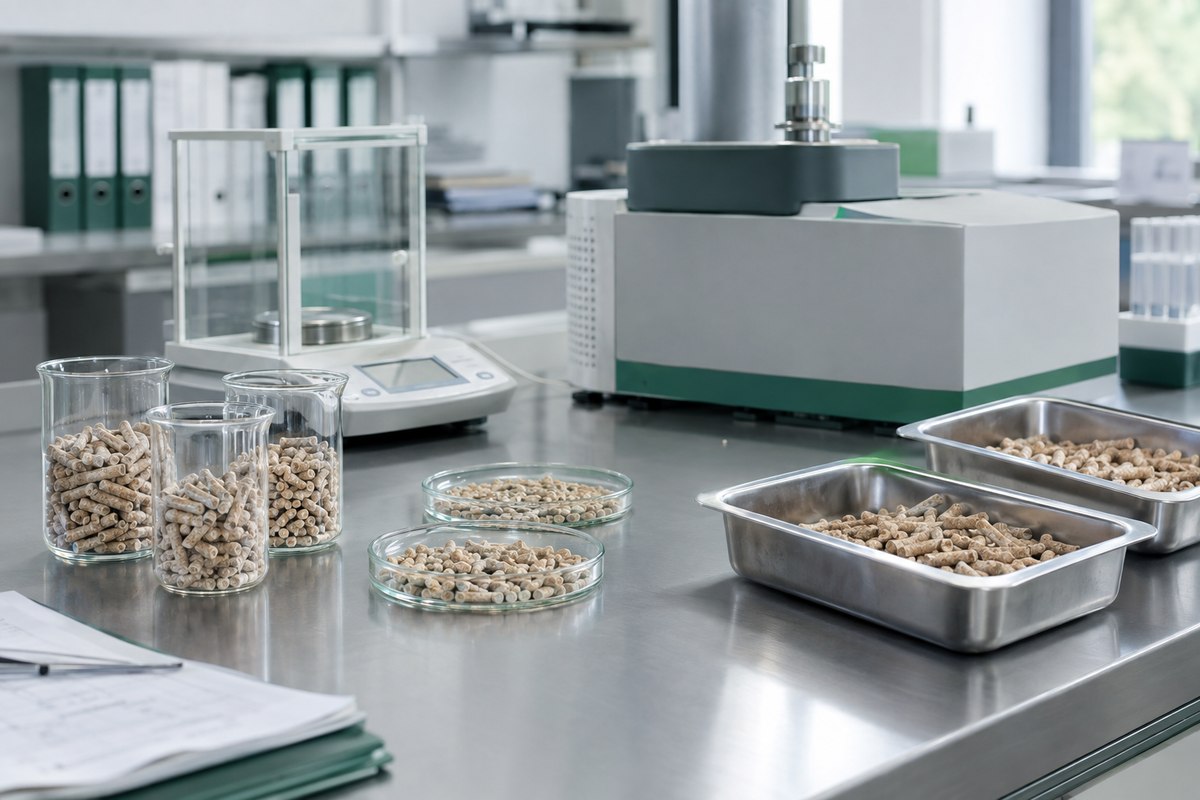
ENplus divides testing into two levels. The internal level consists of checks carried out by the plant: moisture, mechanical durability, bulk density, fine fraction and length — tested frequently, as a rule at least once per shift or per batch, using simple equipment (laboratory sieves, scales, a dryer, a durability tester). Results feed into the batch register and drive the classification decision.
The external level consists of tests in a laboratory indicated or accepted by the certification body (preferably accredited under ISO/IEC 17025): the full set of class parameters — ash, NCV, durability, fines, density, moisture, ash deformation temperature and elements (N, S, Cl, metals). Samples for external testing are taken by the auditor during the initial audit and every surveillance audit, and additional tests may be commissioned when the feedstock or technology changes or following complaints.
A practical tip: the in-house "laboratory" does not have to be expensive, but it must be functional and calibrated. A mechanical durability tester with an uncalibrated drum generates results on which no classification decision can be based — and that is a nonconformity, not a convenience.
The most common audit nonconformities — an auditor's experience
The list below collects problems I have repeatedly seen during preparatory and surveillance audits at pellet-producing plants. Their common feature: they rarely stem from poor technology — almost always from documentation that does not live its own life on the shop floor.
- Lagging monitoring — shift records filled in collectively, less often than the procedure requires; missing results for batches that have already been despatched.
- Fine fraction at the outlet — the screener exists but is clogged, incorrectly set or bypassed during a large order; a result > 1.0% at loading is a critical nonconformity for the class.
- Mixing batches without traceability — a shared silo for batches from different days with no level records; inability to reconstruct the history of a batch delivered to a customer.
- Ash above the class limit — seasonal deterioration of feedstock (bark chips, sawdust from an unpaved yard) with no system reaction: a batch planned as A1 comes out with 0.8% ash and is despatched as A1 "because the customer is waiting".
- Unapproved labelling — a new bag design introduced by marketing without approval; missing PL code on big-bags; the mark used for a class outside the certificate.
- No retention samples — or an archive in which samples are not linked to batch numbers — in the event of a complaint, the plant has nothing with which to defend conformity.
- Calibration of measuring equipment — scales, moisture meters and the durability tester without calibration status or with expired certificates.
- Complaints without root-cause analysis — returns settled commercially but without process conclusions; the same defect returns every season.
- Staff training — new line and screening-station operators without training in system requirements; classification decisions taken by people who do not know the class limits.
The good news is that all of the above points can be closed before the certification audit — provided that the documentation system is built around the real process on the shop floor, not the other way round. An internal audit carried out 4–6 weeks before the certification body's visit usually captures exactly these areas.
Certification costs and timeline — indicative figures
ENplus certification costs consist of several independent items and are always set individually, so treat the values below as orders of magnitude for budget planning, not as an offer:
- Preparation and consultancy — gap analysis, documentation, implementation, internal audit: depending on the plant's maturity, from a few to a dozen or so thousand PLN.
- Certification audit — bodies' rates for the initial audit of one production plant are indicatively several to a dozen or so thousand PLN; surveillance audits are cheaper.
- Laboratory testing — the full class-parameter package: usually PLN 2–5 thousand per test series, depending on the laboratory and scope.
- Scheme fees — the licence and EPC/national licensor fees, dependent among other things on production volume.
- Plant investments — the most variable item: from the cost of printing labels to the installation or modernisation of a fine-fraction screening station.
As for timing: for a plant that already keeps basic quality records, the path from gap analysis to certificate is indicatively 3–4 months. Where technological changes are needed or the system is built from scratch, 5–6 months is realistic. Lead times are extended by waiting periods for external testing and seasonal production peaks — it is best to schedule the start outside the peak of the heating season.